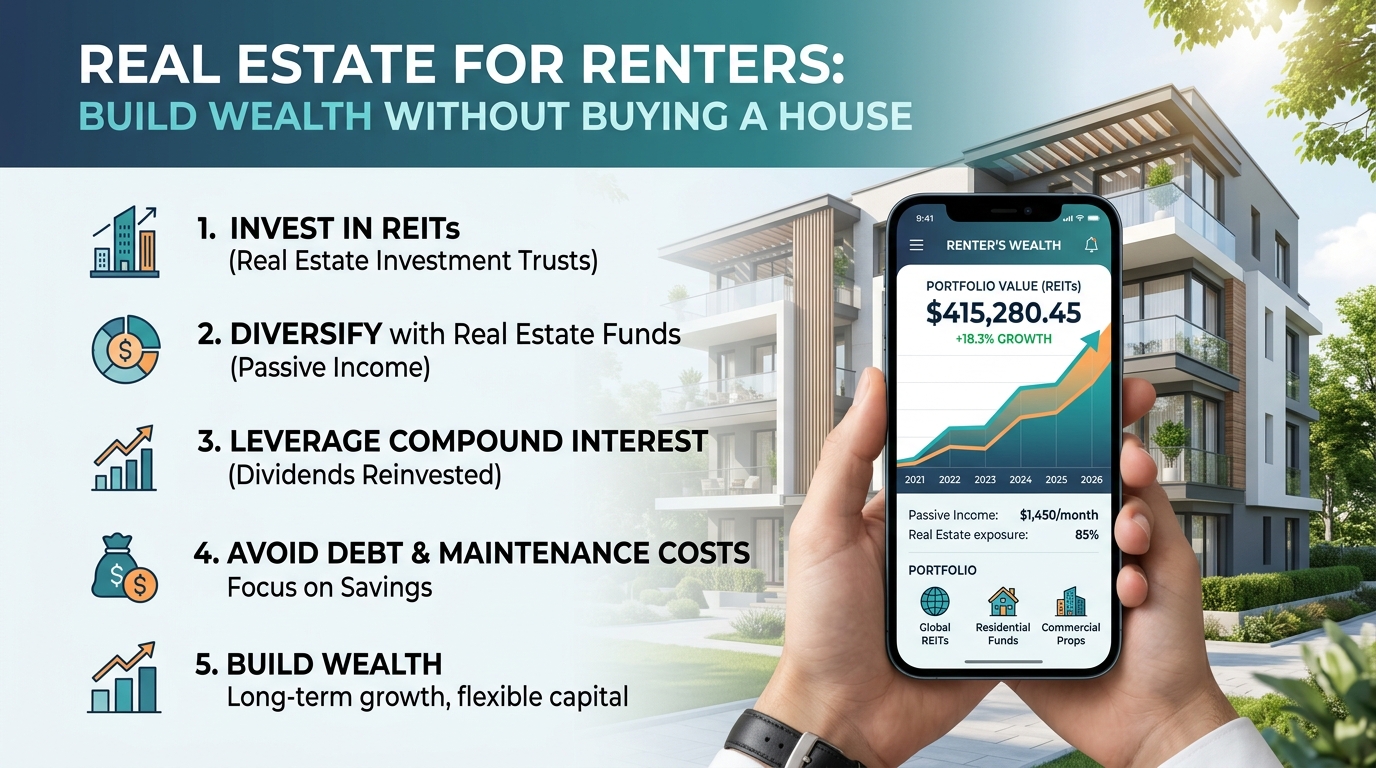
Introduction: The “You Need a House to Build Wealth” Myth That’s Costing You
Let me tell you about my friend Priya. She’s 29, rents a cute apartment in Toronto, and pays $2,400/month in rent. Every time she talks to her parents, they say: “You’re wasting money. Buy a house. Real estate is the only way to build wealth.”
She’s started doubting herself. She looks at house prices in Toronto—average $1.2 million—and feels defeated. “I can’t afford that. I’ll never be rich. I’m just wasting my money on rent.”
But Priya’s wrong. She’s not wasting money. And she doesn’t need to buy a house to build wealth through real estate.
Here’s the truth most people miss: You can invest in real estate as a renter. You don’t need $500,000 in cash. You don’t need a 20-year mortgage. You don’t even need to be a homeowner.
In fact, renters often build wealth faster than homeowners because they’re not stuck with one property. They can invest in 50 different real estate markets with just $5,000.
In this article, I’ll show you exactly how to use real estate for renters to build wealth:
-
Why the “buy a house” advice is outdated (and dangerous)
-
The 5 best ways renters can invest in real estate
-
How REITs work (and why they’re perfect for beginners)
-
The real math: renters vs. homeowners over 20 years
-
A simple 3-step plan to start investing today
Let’s break the myth and show you the real path to wealth.
The Big Misconception: Why “Buy a House” Isn’t the Only Way
The Advice Your Parents Give (And Why It’s Wrong)
Your parents told you: “Real estate = buying a house. That’s how you get rich.”
They’re half right. Real estate is a wealth-building tool. But buying a house is not the only way.
Here’s the problem with that advice:
Buying a house locks you into one property. If that city’s economy crashes, you’re stuck. If the property value drops, you lose money.
Investing as a renter lets you diversify. You can own pieces of apartment buildings in NYC, commercial spaces in London, and vacation homes in Miami—all with $10,000.
Expert tip: Homeownership is not investing. It’s consumption with potential appreciation. True real estate investing is liquid, diversified, and passive.
Real Estate for Renters: The 5 Best Ways to Invest
Method #1: REITs (The Easiest Way for Beginners)
What is a REIT?
A REIT (Real Estate Investment Trust) is like an index fund for real estate. Instead of buying one building, you buy shares of a company that owns hundreds of properties.
When those properties collect rent, you get paid. It’s passive income without being a landlord.
How it works:
-
You buy REIT shares (like stocks)
-
The REIT owns apartment buildings, malls, hotels, etc.
-
Those properties collect rent from tenants
-
The REIT pays you 90% of the profits as dividends
That’s the legal requirement: REITs must distribute 90% of income to shareholders.
Best REITs for 2026:
Why REITs are perfect for renters:
-
Low cost: Start with $100
-
Liquid: Sell anytime (unlike a house)
-
Passive: No maintenance, no tenants
-
Diversified: 150+ properties in one fund
Rule: REITs are the closest thing to “real estate investing without owning a house.”
Method #2: Real Estate Crowdfunding (The Modern Way)
What is crowdfunding?
Crowdfunding is like group buying. You and 100 other people pool money to buy a property. You each own a percentage. When the property rents or sells, you get your share.
How it works:
-
You pick a platform (Fundrise, RealtyMogul, etc.)
-
You choose a property (apartment, office, storage)
-
You invest $500–$5,000
-
The property rents to tenants
-
You get monthly or quarterly income
Best platforms for 2026:
Why crowdfunding works for renters:
-
Low barrier: Start with $10 (Fundrise)
-
No landlord stress: Platform manages everything
-
Diversified: Invest in multiple properties
-
Transparent: See all property details upfront
Pro tip: Crowdfunding gives you “direct ownership” of real estate without the hassle.
Method #3: Real Estate ETFs (The “Set It and Forget It” Way)
What’s the difference between REITs and ETFs?
-
REITs: Individual companies that own real estate
-
Real Estate ETFs: Funds that hold many REITs (like an index fund)
Example: The XLRE ETF holds 30+ REITs. You buy one share, and you own pieces of all 30 REITs.
Best Real Estate ETFs:
Why ETFs are great for renters:
-
One-click diversification: 30+ REITs in one fund
-
Ultra-low cost: 0.10% expense ratio
-
Passive: No research needed
-
Liquid: Sell anytime
Rule: ETFs are the “lazy person’s” way to invest in real estate.
Method #4: Real Estate Mutual Funds (The Long-Term Way)
What’s a mutual fund?
A mutual fund is like an ETF, but you buy/sell at the end-of-day price (not during the day). They’re great for long-term investors.
Best Real Estate Mutual Funds:
Why mutual funds work:
-
Automatic investing: Set up monthly contributions
-
Professional management: Fund managers pick the REITs
-
Long-term focus: Designed for 10+ year holds
Method #5: Rental Property via LLC (The “Smart Homeowner” Way)
Wait, you said renters can’t buy property?
Actually, you can buy a rental property as a renter. You just don’t live in it.
How it works:
-
You buy a duplex or small apartment (2–4 units)
-
You live in one unit (owner-occupied = lower mortgage rate)
-
You rent out the other units
-
Your tenants pay your mortgage
This is called “house hacking” and it’s how many people start real estate investing.
Example:
Your tenant’s rent covers 83% of your mortgage. You’re effectively living for $300/month.
Why this works for renters:
-
Low personal cost: Tenant pays most of mortgage
-
Appreciation: Property value grows over time
-
Cash flow: Eventually, rent exceeds mortgage
-
Tax benefits: Deduct mortgage interest, maintenance
Warning: This requires $80K+ in cash and is not “passive.” You’re still a landlord.
The Real Math: Renters vs. Homeowners Over 20 Years
Let’s Compare the Numbers
Here’s the brutal truth: Homeowners don’t always win.
Let’s compare two people:
Person A (Homeowner):
-
Buys a $500,000 house in 2026
-
20% down ($100,000)
-
30-year mortgage at 6%
-
Pays $2,400/month mortgage + $300/month maintenance + $200/month taxes
-
Total: $2,900/month
Person B (Renter + Investor):
-
Rents for $2,400/month
-
Invests $100,000 (same as down payment) in REITs
-
REITs yield 4% annually + 7% appreciation = 11% total return
-
Total: $2,400/month rent
After 20 years:
The verdict: After 20 years, the renter + investor has $950,000, while the homeowner has $903,000. The renter also paid $500/month less per month and had zero maintenance stress.
Key insight: Homeownership is not automatically better. It depends on your strategy.
Real Estate for Renters: Step-by-Step Plan to Start Today
Step 1: Open a Brokerage Account (5 Minutes)
You need a place to buy REITs, ETFs, or crowdfunded properties.
Best brokers for real estate investing:
Process:
-
Download the app
-
Click “Open Account”
-
Fill in your info
-
Link your bank
-
Transfer $100
Step 2: Buy Your First REIT (1 Minute)
Search for VNQ (Vanguard Real Estate) or XLRE (Real Estate Select). Buy $100–$500.
You now own 150+ real estate properties. Congrats.
Step 3: Set Up Automatic Monthly Contributions
This is the real secret. Your $100 is the spark. Consistency is the fire.
Set up automatic transfers:
-
$100/month into REITs → ~$80,000 in 15 years (11% return)
-
$200/month into REITs → ~$160,000 in 15 years
-
$500/month into REITs → ~$400,000 in 15 years
Most apps (Fidelity, Vanguard) let you automate this.
Rule: Automate your investments so you never have to think about it.
Common Mistakes Renters Make (And How to Avoid Them)
❌ Mistake #1: Thinking “I Can’t Invest Without a House”
Wrong. You can invest in REITs, ETFs, crowdfunding with $100. No house needed.
❌ Mistake #2: Buying One REIT Instead of Diversifying
Don’t just buy VNQ. Add XLRE (U.S.) + VNQI (international). That’s 200+ properties.
❌ Mistake #3: Checking Prices Daily
REITs fluctuate. Don’t watch daily. Check once per quarter.
❌ Mistake #4: Paying High Fees
Avoid REITs with expense ratios above 0.50%. Stick with under 0.12%.
Conclusion: You Don’t Need a House to Build Real Estate Wealth
Here’s what you now know:
-
✅ Real estate for renters is real: REITs, ETFs, crowdfunding, mutual funds
-
✅ REITs are the easiest way (start with $100, 3–5% dividends)
-
✅ Crowdfunding gives direct ownership (Fundrise, $10 minimum)
-
✅ The math: Renters + REITs often beat homeowners over 20 years
-
✅ 3-step plan: Open account → Buy VNQ → Automate $100/month
The biggest myth? “You need to buy a house to build wealth.” That’s wrong. You can build more wealth as a renter by investing in real estate indirectly.