Introduction: The Investing Problem That Keeps You Stuck at Night
Let me tell you about my friend Jake. He’s 34, works 60 hours a week as a software engineer, and knows he should be investing. But every time he opens his brokerage app, he gets overwhelmed.
“Which stock should I buy? Apple or Tesla? Should I diversify? What if I pick the wrong one and lose everything?”
He’s looked at investing blogs, watched YouTube videos, and even tried day trading for two weeks. Spoiler: He lost $1,200.
Now he’s stuck. He’s terrified to invest, but he also knows that not investing is costing him tens of thousands of dollars in compound growth.
If you’re feeling this same frustration, you’re not alone. Most people—especially busy professionals—don’t have time to research stocks, track market news, or read financial reports.
But here’s the secret: You don’t need to. There’s a smarter way.
It’s called index funds, and it’s the foundation of passive investing for busy people. Warren Buffett, John Bogle (founder of Vanguard), and millions of everyday investors use this strategy to build wealth without the stress.
In this article, I’ll break down everything you need to know in plain English:
-
What an index fund actually is (no finance jargon)
-
How passive investing works (and why it beats stock picking)
-
The best index funds for 2026 (with real examples)
-
Why low-cost funds are the secret weapon
-
How to start investing with just $100
-
A simple 3-step plan you can follow today
Let’s make investing simple again.
What Is an Index Fund? (The Simple Explanation)
The “Basket of Everything” Analogy
Imagine you want to invest in the stock market, but you’re not sure which company to pick. Apple is great, but what if it crashes? Tesla is hot, but what if it fails?
Instead of picking one company, you buy a basket of hundreds (or thousands) of companies. That basket is an index fund.
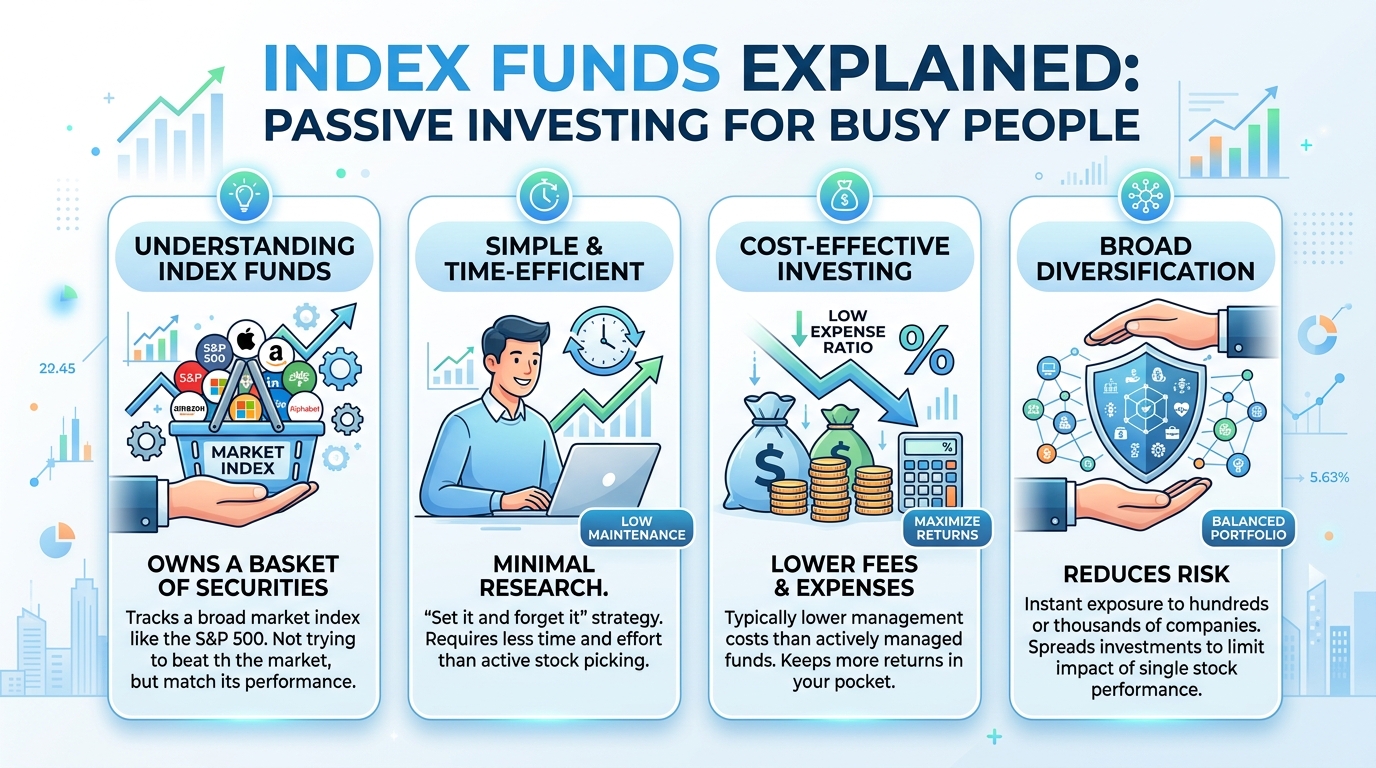
An index fund is a mutual fund or ETF that tracks a specific market index, like the S&P 500. When you buy one share of an S&P 500 index fund, you’re instantly owning a tiny piece of all 500 companies in that index.
Simple analogy: Individual stock = betting on one horse. Index fund = betting on the entire track.
Real Examples of Index Funds
The key takeaway: With one fund, you own everything. No stock picking. No research. Just instant diversification.
How Passive Investing Works (And Why It Beats Stock Picking)
The Active vs. Passive Investing Debate
There are two ways to invest:
-
Active Investing: You pick individual stocks. You research companies. You try to “beat the market.”
-
Passive Investing: You buy index funds. You own the entire market. You match the market’s return.
Most people think active investing is better. They watch CNBC, read stock tips, and try to find the “next Apple.”
But the data says passive investing wins.
The Proof: Passive Investing Beats 90% of Active Managers
Here’s the brutal truth: 90% of active fund managers fail to beat the S&P 500 over 15 years. Even professional Wall Street analysts can’t do it consistently.
Warren Buffett’s bet: In 2008, Buffett bet $1 million that an S&P 500 index fund would beat hedge funds over 10 years. He won. Index funds returned 7.1% annually. Hedge funds averaged 2.2%.
Why Passive Investing Wins
Passive investing is simpler, cheaper, and more reliable. That’s why it’s perfect for busy people.
The 3 Biggest Benefits of Index Funds (Why You Should Use Them)
Benefit #1: Instant Diversification (No Brain Required)
When you buy one stock, you’re betting on one company. If that company fails, you lose everything.
When you buy an index fund, you’re betting on the entire market. If one company crashes, 499 others keep you safe.
Example: In 2022, Tesla dropped 65%. But the S&P 500 only dropped 19%. If you owned Tesla alone, you’re devastated. If you owned an S&P 500 index fund, you’re fine.
Rule: Diversification is the only “free lunch” in investing. Index funds give you instant diversification.
Benefit #2: Ultra-Low Costs (The Secret Weapon)
Index funds are cheap. Here’s why:
-
No human managers (a computer tracks the index)
-
No research teams (the index is pre-made)
-
Low trading fees (the fund rarely buys/sells)
Typical costs:
Over 30 years, that 1% difference costs you $50,000+ on a $100,000 portfolio. Low-cost funds are your secret weapon.
Benefit #3: Passive Investing = Less Stress (Finally Sleep at Night)
When you pick individual stocks, you check prices daily. You panic when the market drops 5%. You FOMO when a stock goes up 20%.
When you own index funds, you ignore the market. You know the market will go up long-term. You don’t need to watch it.
John Bogle (Vanguard founder): “Don’t look for the needle in the haystack. Buy the haystack.”
Passive investing means you stop trying to beat the market and start matching it. That’s the whole game.
The Best Index Funds for 2026 (Real Recommendations)
Top 5 Index Funds for US Investors
My top pick: VT (Vanguard Total World). With one fund, you own 9,000+ companies globally. No need to rebalance. No need to think. It’s the ultimate “set it and forget it” fund.
Top 3 Index Funds for UK Investors
How to Start Investing in Index Funds (3 Simple Steps)
Step 1: Open an Account (Takes 10 Minutes)
You need a brokerage account. Here are the best ones:
Process:
-
Download the app
-
Click “Open Account”
-
Fill in your info (SSN/National ID, bank details)
-
Link your bank
-
Transfer $100
Step 2: Buy Your First Index Fund
Once your account is open:
-
Search for the ticker (e.g., VT)
-
Click “Buy”
-
Enter how much you want (e.g., $100)
-
Confirm
You now own 9,000+ companies. Congrats.
Step 3: Set Up Automatic Monthly Contributions
This is the real secret. Your $100 is the spark. Consistency is the fire.
Set up automatic transfers:
-
$50/month → ~$20,000 in 15 years (10% return)
-
$100/month → ~$40,000 in 15 years
-
$200/month → ~$80,000 in 15 years
Most apps (Fidelity, Vanguard, Trading 212) let you automate this. Turn investing into a habit, not a chore.